
Why Retailers Need Real-Time Store Performance Visibility
The Problem Hiding in Plain Sight

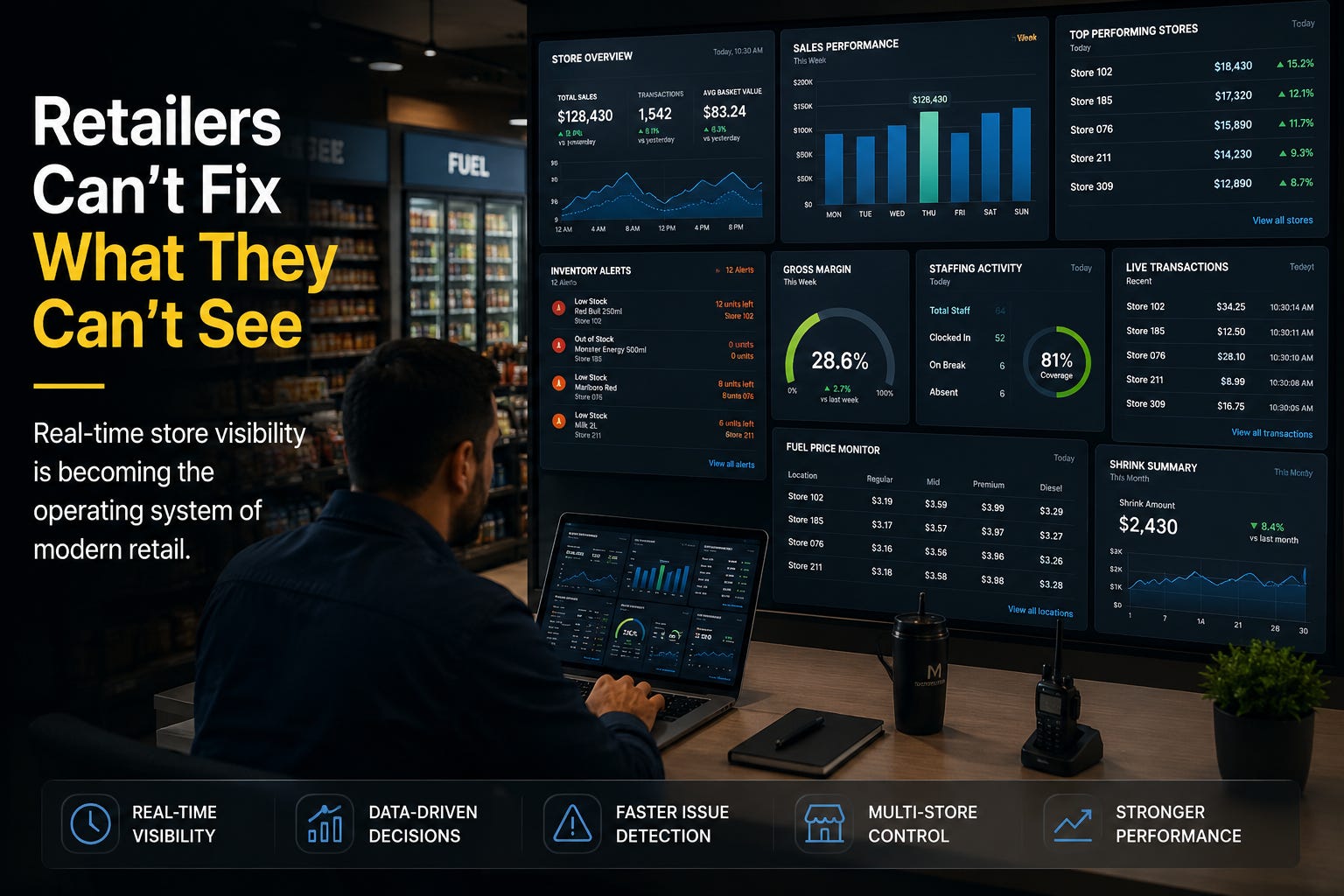
It’s 11:47 PM. The last shift closed two hours ago, and a convenience store manager is only now reconciling the day’s numbers. The end-of-day report has finally populated seven hours after a pricing error on premium fuel went live and ran uncorrected through 340 transactions. The register discrepancy from the afternoon cashier? Discovered at midnight, with nothing actionable left to do.
This isn’t a story about bad management. It’s a Tuesday.
Across a chain of twelve locations, moments like this compound quietly. A cooler malfunction wasn’t flagged until the next morning’s rotation. A promotional bundle ran at the wrong price for six hours. One store ran out of a high-velocity SKU by 2 PM and didn’t reorder until the following day’s stock check. None of it catastrophic in isolation — but together, across twelve stores and five days, it added up to thousands in margin erosion that nobody saw in time to stop.
The problem wasn’t people. It wasn’t process. It was visibility, specifically, the absence of it.
Why Traditional Reporting Systems Are Failing Retailers
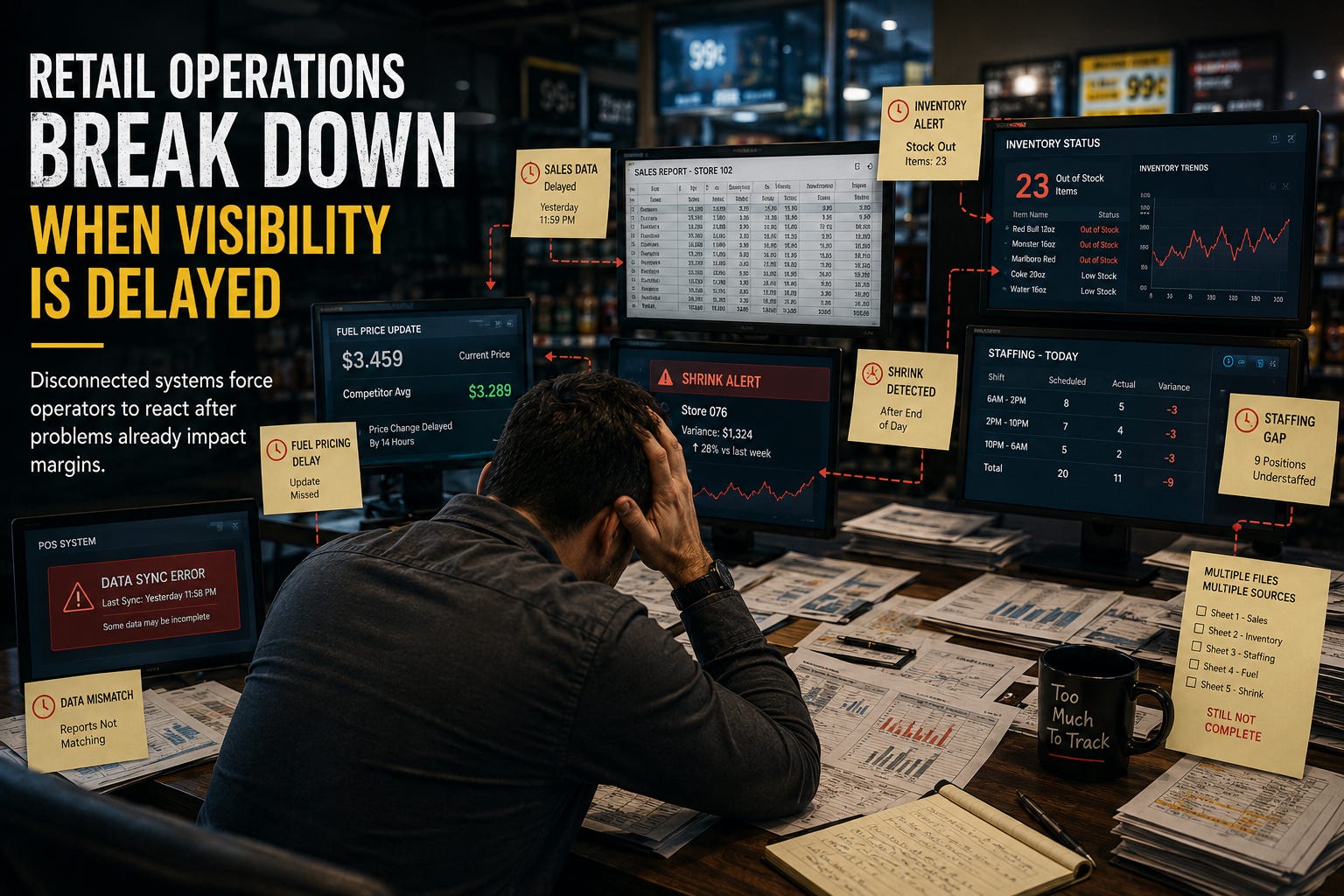
The retail industry has spent a decade investing in customer-facing technology while leaving the operational back-end largely unchanged. Most convenience store and fuel retail operators still run their businesses through a patchwork of disconnected systems POS, fuel management, inventory, time-and-attendance, cash management that don’t share data in real time. Each one generates records that feed into reports reconciled, at best, once a day.
This is operational fragmentation at its most consequential. And it scales badly. A single-location operator can compensate through proximity — they’re in the store, watching, adjusting. Managing fifteen or fifty locations, that proximity disappears and fragmentation becomes structural blindness.
End-of-day reporting was designed for a world where retail moved more slowly. That world no longer exists. A busy c-store today sees fuel prices that may need updating two or three times before noon, promotions that need real-time execution confirmation, cashier shifts turning over multiple times, and fresh food cycling through pull times all day. Every one of those moments generates operational data. Under legacy systems, it surfaces in a report the next morning or the morning after that.
A store performance dashboard that only updates at close isn’t a performance tool. It’s a historical record. And historical records have zero value for in-the-moment operational management.
The spreadsheet layer makes it worse. Regional managers who’ve moved beyond batch reporting often still manually aggregate exports from multiple systems into a single workbook every Monday morning a process that delays decision-making by days and introduces just enough inconsistency to make the analysis only marginally trustworthy.
Meanwhile, pricing corrections happen late, shrink detection happens after the damage is done, and cashier anomalies early voids, excessive refunds, suspicious transaction patterns don’t surface until after the shift has ended.
The Hidden Cost of Delayed Store Visibility
The losses that show up on a P&L are the visible ones. The losses that quietly kill retail margins are the ones delayed visibility lets run undetected no single incident alarming enough to investigate, but the cumulative pattern representing real profit erosion.
Fuel pricing delays are among the most financially significant. In a market where rack prices shift multiple times per day, a two-hour lag in price execution costs real margin per gallon across high-volume periods. Multiply that across a network of locations and 365 operating days, and it’s not trivial.
Inventory mismatch creates a different kind of damage. When system stock levels don’t reflect shelf reality because shrink wasn’t logged, a receiving entry was missed, or a vendor short-loaded without a credit operators make restocking decisions based on numbers that don’t exist. Out-of-stocks during peak hours mean lost sales and lost customer trips. Over-ordering based on phantom inventory ties up cash in product that isn’t moving.
Shrink detection delay is perhaps the most normalized form of loss in convenience retail. A cashier running a refund scheme might do it for weeks before a reconciled report catches the pattern. A vendor short-loading weekly deliveries can do so for months if the discrepancy only appears in a report nobody scrutinizes carefully. Real-time shrink visibility doesn’t eliminate loss — it compresses the window between anomaly and response.
Promotion execution gaps are underestimated. When a price promotion fails to apply at the POS — a failed system update, a configuration error the store either undercharges (margin loss) or overcharges (compliance risk). Without real-time transaction monitoring, that misconfiguration can run for hours across every register in a fifteen-store network.
None of this is hypothetical. It happens in stores every day.
Why Real-Time Visibility Changes Retail Operations
Real-time operational visibility isn’t a reporting upgrade. It’s a structural change in how a retail organization relates to its own operations — a shift from reactive to proactive that, for multi-location retailers, is the difference between managing crises and preventing them.
When a district manager has a live store performance dashboard surfacing anomalies as they happen — a drawer running off, a fuel island showing unexpected declines, transaction velocity dropping sharply mid-shift — they can respond while the event is still in motion. That’s categorically different from an end-of-day exception report requiring reconstruction of what went wrong twelve hours later.
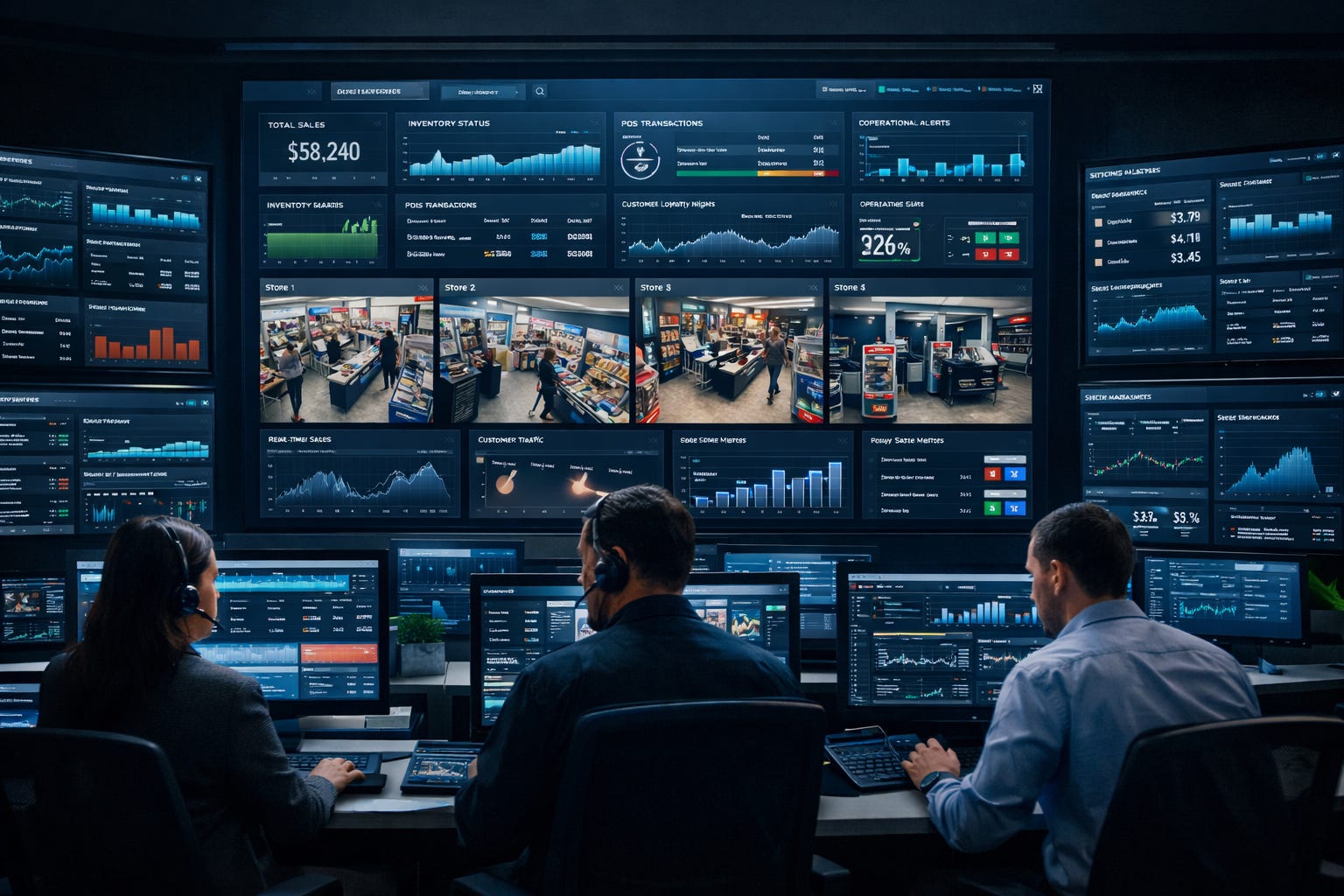
Centralized operational intelligence also changes the economics of multi-location management. Instead of weekly store visits to observe what’s happening physically, a regional manager can monitor operational health across their entire territory from a single view directing their presence to the locations that actually need it. Real-time visibility doesn’t just improve decisions; it makes scarce management attention dramatically more effective.
For convenience and fuel retail specifically, the variables that matter most fuel pricing, inventory positions, transaction integrity, staffing alignment, promotional execution move fast and interact in complex ways. A busy afternoon where fuel pricing is stale, the coffee station is empty, and two registers are running with undertrained staff isn’t three separate problems. It’s a compounding operational failure that unified retail analytics would have flagged hours before it showed up in the numbers.
Platforms like MOSTEDGE Store Pulse represent a different category of tool than traditional back-office reporting operational infrastructure rather than periodic summaries. The retailers who’ve adopted this approach consistently describe the same transition: they stop discovering problems and start intercepting them.
The Future of Retail Operations Is Real-Time
The direction of retail technology is clear. AI-driven operations are already moving beyond dashboards into predictive territory inventory models that anticipate stockout risk based on current velocity, staffing algorithms that flag upcoming coverage gaps, fuel pricing engines recommending adjustments based on live market conditions. These capabilities don’t exist independently of real-time operational visibility. They depend on it as their foundation.
The unified operational ecosystem — where inventory, POS, fuel management, labor, and cash management flow into a single intelligence layer — is the logical endpoint. A promotional decision informed by real-time inventory positions, current transaction velocity, and live staffing levels across a store network is a fundamentally better decision than one made from Monday’s spreadsheet.
Disconnected systems aren’t just inefficient anymore. They’re incompatible with the speed at which modern retail competition operates. A retailer whose competitor adjusts fuel prices every forty minutes, monitors promotional compliance in real time, and flags staffing anomalies before they affect service cannot compete on equal footing against a 24-hour reporting lag.
Operational Intelligence Is Now the Baseline
There’s a version of retail leadership defined by instinct — the experienced operator who walks a store and immediately senses what’s off. That kind of pattern recognition is genuinely valuable. But it doesn’t scale across fifteen locations, and it can’t monitor six active registers simultaneously.
The retailers defining the next decade of convenience and fuel retail aren’t necessarily the ones with the sharpest instincts. They’re the ones who’ve systematically extended their ability to see replacing assumption and inference with continuous operational intelligence that makes the entire organization faster and more precise.
Visibility is no longer a competitive advantage. It’s the new operational baseline. The leaders in this industry have already moved past asking whether they need real-time store performance visibility. They’re asking what to do with it.
The more important question for everyone else: how much are you losing while you wait?